
OUR TAKE · Cargo Technology and Distribution
Volatus's drone contract faces a receiving-desk test
Volatus has announced a scheduled drone link between two logistics sites. Its value depends on the receiving deadline, missed flights and the road service it replaces.
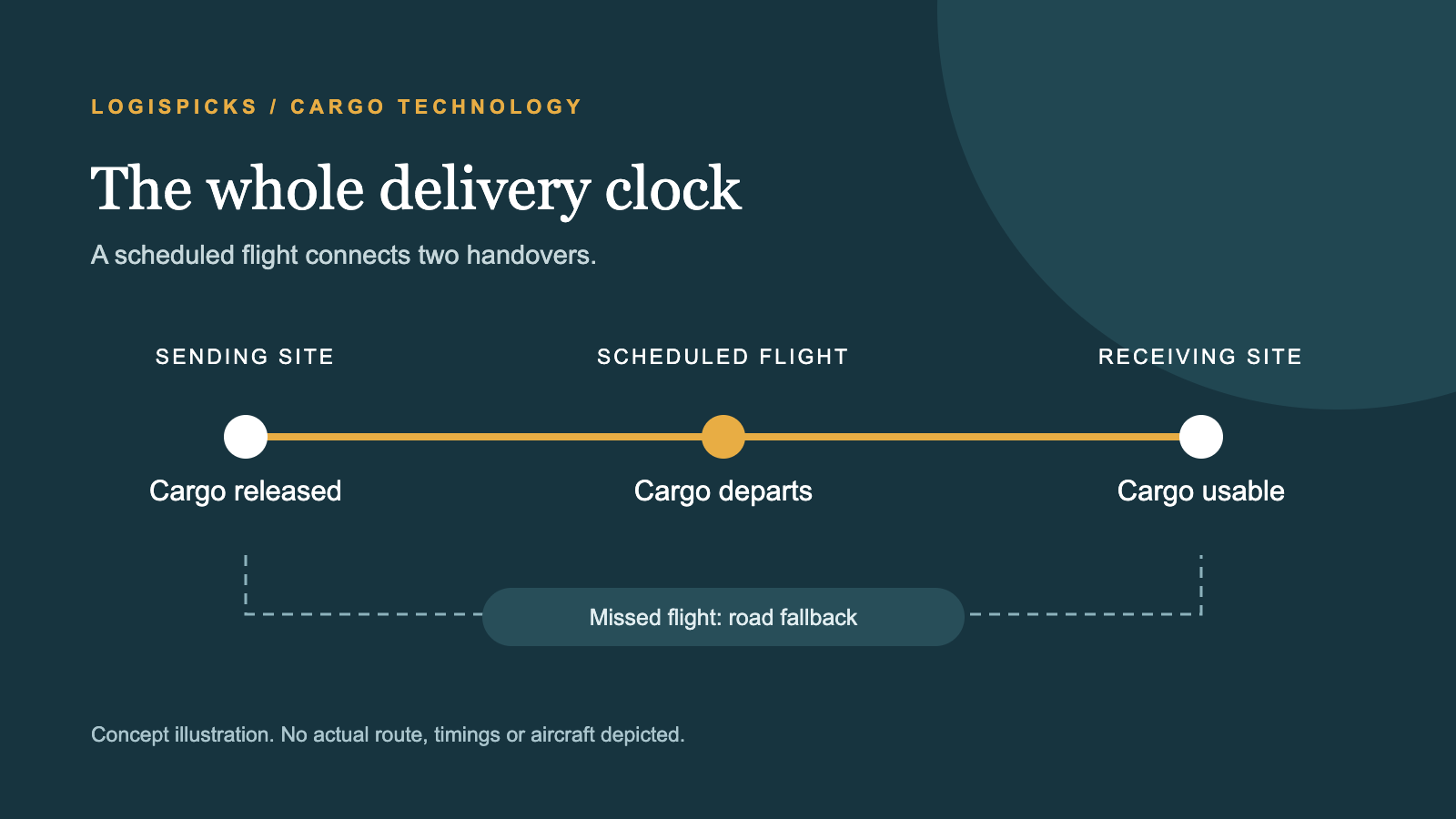
Original LogisPicks concept diagram of a scheduled cargo transfer. No actual route, aircraft or measured timings are depicted.
A scheduled drone link earns its place when it gets a useful shipment to the receiving desk in time. Flight speed alone cannot show whether it will do that, especially if packing, waiting for departure or unloading consumes the time saved in the air.
Volatus Aerospace announced on November 24 that it has signed a contract to move cargo between two locations belonging to an unnamed major North American logistics company. The company describes a Canary drone with payload capability up to 5 kg and range up to 30 km. The initial deployment is designed for up to six round trips per scheduled operating day.
Those are stated capabilities and a proposed operating pattern. The release does not establish a record of six completed round trips per scheduled operating day, a delivered cost per shipment or improved service for the customer. It leaves a more interesting commercial question open: which transfer is valuable enough to justify a dedicated aerial service?
The shipment has to arrive before something else happens
A small load can have a large operational value if another process is waiting for it. The relevant comparison is between the receiving deadline and the complete journey from release at the sending site to availability at the destination.
That journey includes packing, handover, departure waiting time, flight and receipt. For a scheduled service, the waiting time deserves particular attention. A parcel ready just after a departure can miss the opportunity that makes the route attractive, even if the aircraft itself is fast.
Take an illustrative case, not a report of this contract: a distribution centre needs a component before its afternoon dispatch closes. The proposed drone offer should state the latest release time at the sending site and the time the component becomes available at the receiving desk. The existing road offer should be described in the same terms. Comparing flight time with driving time would leave out the handovers on both sides.
The buyer can then identify the shipments that would gain a useful departure or avoid an urgent road movement. Cargo that can comfortably wait for a vehicle already making the trip presents a different business case. Allocating the van's entire cost to a parcel that would not eliminate that journey would exaggerate the saving.
A missed flight belongs in the price comparison
Volatus has not disclosed the contract's financial terms. A buyer therefore cannot infer from the announcement that drone transport is cheaper than the road service it might replace. The model also requires supporting ground infrastructure, according to the company.
For procurement, the comparison needs a normal operating case and a missed-flight case. Who books the substitute vehicle, what response time does it offer, and who pays? A low flight price becomes less useful if a cancelled movement still requires an urgent road collection and the recipient misses its dispatch.
The same logic applies to capacity. Maximum payload and range are screening parameters, not a promise that any 5 kg consignment can travel on every departure. The service offer needs to describe the cargo it will accept and the conditions under which it operates.
Approval attaches to the operation
Volatus says remote operations will be managed from Vaughan, Ontario. That does not disclose the two route endpoints. For Canadian operations, Transport Canada requires Level 1 Complex pilots to operate under an RPAS Operator Certificate and use drones meeting the relevant safety requirements. This is regulatory context, not confirmation that the unnamed route is Canadian or has a particular authorisation.
An operator's general credentials and the accepted service on a particular route belong in the same purchasing file. Neither a central control room nor an aircraft specification tells the customer which departures it can rely on.
The contract is worth watching because it ties drone cargo to two points in an established distribution network. The next evidence to look for is accepted shipments, arrival before the receiving deadline, recovery after missed flights and the total cost of making those deliveries.