
OUR TAKE · Ocean Freight and Network Planning
Maersk's megaships put the port call in focus
Maersk's 12 new 24,000-TEU ships are due in 2030–31. Shippers need to know how larger calls could affect cargo availability and inland collection.
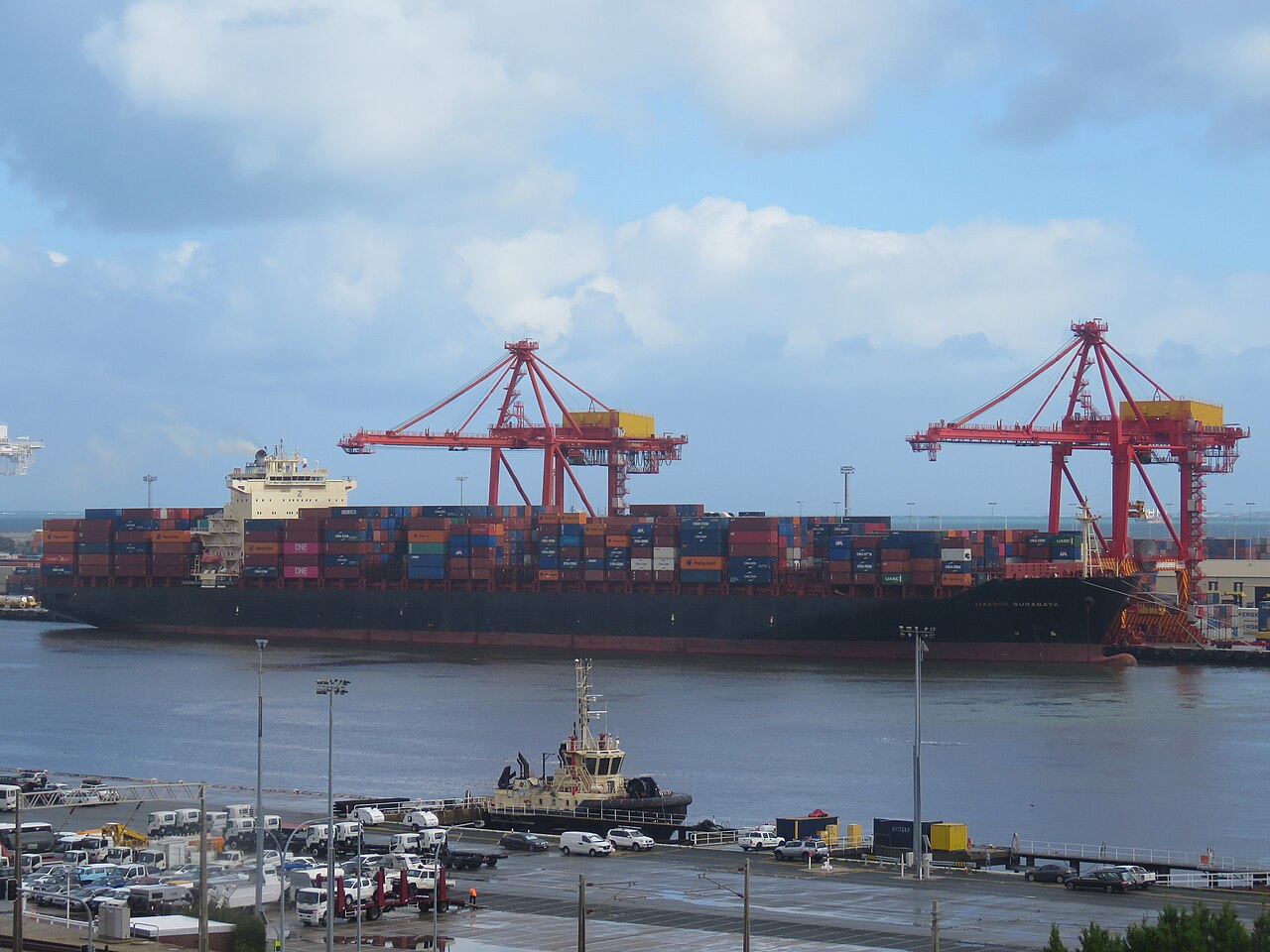
Maersk Surabaya at Fremantle Harbour, 28 July 2021. Historical illustration, not one of the new 24,000-TEU ships. Photo: Calistemon / Wikimedia Commons, CC BY-SA 4.0. Source thumbnail displayed with responsive cropping.
A shipper buys a departure and a delivery plan. Maersk's latest order is a reason to look more closely at how the two connect: a larger vessel can bring more cargo to a port without making that cargo available to the receiving warehouse any sooner.
On November 24, Reuters reported Maersk's confirmation of an order for 12 container ships of 24,000 TEU each. Delivery is scheduled for 2030 and 2031. TEU measures capacity in twenty-foot container equivalents. These will be the largest vessels in Maersk's fleet, the company said.
That is a long-term investment announcement, not additional space for this season's exports. Its relevance to cargo owners lies in the operating choices that will follow: which services receive the vessels, which ports they call, and how the cargo moves away from those calls.
More cargo at a call can move the pressure inland
The economics of a larger ship and the economics of an importer's delivery are different calculations. The carrier can spread a voyage's costs across more containers if enough cargo is available. The importer still needs a particular box released, collected and delivered within a useful window.
Where a larger vessel produces a larger exchange at a terminal, the extra work arrives as a batch. Cranes discharge the boxes; the yard must hold and position them; trucks or trains must then take them away. A berth able to receive the vessel answers only the first part of that problem.
This is a conditional effect, not a forecast of congestion at an unnamed port. A terminal with spare handling capacity and well-matched inland services may absorb a bigger exchange. A shipper whose collection plan already depends on a narrow appointment window has more reason to examine how that exchange will be handled.
For a network tender, the useful comparison is therefore between complete routings. One option might offer a direct call but a concentrated collection window. Another might involve a connection and a different inland schedule. The procurement team needs the time from cargo availability to delivery, alongside the ocean transit, to judge either offer.
Maersk still has reasons to value different ship sizes
The new order does not make the rest of the fleet irrelevant. In its February 9 announcement of eight 18,600-TEU vessels, Maersk explicitly favoured deployment flexibility. Those ships were described as more compact than the largest vessels then being built, with more options across its network.
Now, The Maritime Executive reports a company spokesperson describing the 24,000-TEU vessels as suited to its most cargo-intensive services. Read together, the statements support a fleet with different jobs for different sizes. They do not establish that every route will move to larger vessels.
Nor does adding up the new ships establish net capacity growth. That calculation would also need the vessels they replace, any charter returns and the eventual deployment plan. An orderbook is useful evidence of investment; it is an incomplete guide to the capacity a customer will be offered.
Put cargo availability into the tender
Cargo owners can use the announcement to sharpen a future service discussion without inventing a 2030 operating plan today. Alongside the proposed weekly departure, ask for the destination terminal, the expected cargo-availability window and the inland service on which the delivery promise depends.
Those details should travel together in a routing comparison. A faster ocean leg loses part of its value if it leaves the buyer paying for an extra truck movement or holding stock for a later receiving slot. Conversely, a larger call can work well where terminal handling and inland departures fit the cargo owner's needs.
The decisive information will be the published service design and the commitments attached to a booking. Until those exist, the order gives buyers a reason to examine the port-to-warehouse leg more carefully, rather than a reason to rewrite their delivery assumptions.